In questo sito utilizziamo dei cookies per rendere la navigazione più piacevole per i nostri visitatori. Cliccando sul link sottostante "Policy – Cookies e tutela della Privacy" puoi trovare le informazioni su cosa sono i cookies.

WITH THE FREE PATRONAGE OF
logo carnevale putignano
CARNEVALE DI PUTIGNANO
logo chiesa di san pietro

CHURCH OF SAN PIETRO APOSTOLO

italian.png
Putignano a history you don't expect

itinerario monumenti

percorso chiese

Associazione Putignanese Turistica

certificato tripadvisor

logo visita putignano

logo grotta del trullo

museo putignano

logo museo diffuso carnevale di putignano

logo teatro putignano

Cavalieri di Malta a Putignano

logo propaggini putignano

logo accademia delle corna
Carnival Thursdays

The official and ongoing celebrations of the Putignano Carnival begin after 17 January which is the feast of Saint Anthony the Abbot also known as Saint Anthony of Fire. The Putignanesi in this period remember him with the saying "Sant'Antun, masck'r i sun" and that is Sant’Antonio masks and sound. On January 17, the blessing of the animals and that of the native mozzarella also occurs in the town.


Papier-mâché's Art

 
The artistic processing of papier-mâché takes hold in Putignano, as already seen, around the 40s. An art that notoriously uses poor materials such as newspaper, specifically daily paper, glue obtained from the mixture of water and flour and then acrylic colors to paint the artifacts.
 
The processing starts from the 3D realization of the paper sketch, a clay bas-relief is molded which constitutes the positive. Once this cast has been worked, the negative is obtained by pouring liquid plaster on the positive.
 
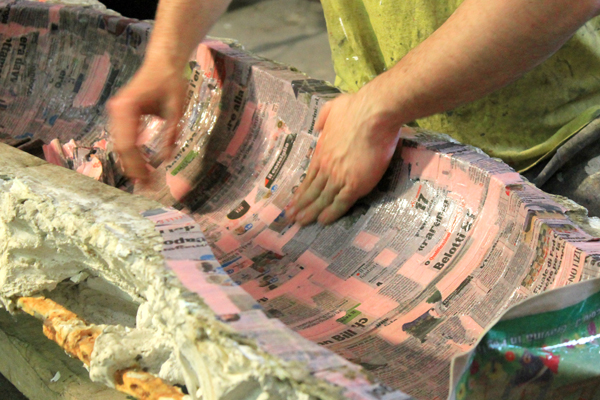
The negative, otherwise known as the "female" of the cast, will be used as a three-dimensional guide for the application of newspaper clippings dipped in the flour glue which will then generate the product. For the storage of the newspapers, they tended to be separated by color, so the newspapers of the famously pink "Gazzetta dello Sport" were put on one side, then those of "Il Sole24Ore" in a powder beige color, those of "Italia Oggi" recognizable because they are yellow and finally all the rest of the white newspapers. The motivation for this subdivision is linked to the processing and specifically to the overlapping of the layers, in fact a minimum of mechanical resistance to shocks of the works is superimposed on multiple levels of newspaper, from 3 to 4. In this regard, to highlight uniformity and completeness of each level you use the newspaper differentiates. For example, knowing that the first layer is pink, the second is yellow and the third is white, allows us to establish that the artifact is in the first, second or third step.
 
Once the raw material has been obtained, the papier-mache master moves on to the finishing phase through coloring. Acrylic colors are used. We proceed first to the bases and then to the shades to accentuate features or lights and shadows.
 
This artistic technique, in addition to these more or less known ingredients, also presents tricks and secret working methods that the papier-mache masters jealously hand down from generation to generation.
Il Carro allegorico "più ti denudi e men c'illudi" Putignano 1949

In the immediate post-war period and to be precise from 1946, after the war break, allegorical floats were resumed and together with Fedele Dalessandro and Rocco Faniuolo other tankers dedicated themselves to the artistic realization of artistic artefacts in papier-mâché. Among these we should mention Angelo Notarangelo (Iang'l u zupp), Giuseppe Bianco and the painter Peppino Costanzo. The involvement of several generations in the art of papier-mâché processing is now evident and the first of Fedele Dalessandro's school was joined by the young son Valentino, who with the collaboration of three other colleagues and friends, Franchino Netti (u musch'vet), Tonino Pagliarulo and Armando Genco improved the quality of the puppets.


Guided by the creative flair of Genco, the four managed to make the papier-mâché characters more realistic and dynamic in their features, through a more accurate modeling of the wire. The lines of the profiles were thus emphasized and the puppet was no longer squashed or squared as in the past. The first chariot that contained these new dynamics was entitled "Più ti denudi e men c'illudi" from 1949 which, moreover, caused a sensation for a daring neckline that prompted the then archpriest Don Saverio Losavio to scold heavily the four young people artists. The following year, in 1950, the group built another chariot with the same technique entitled "Two girls and a sailor".


Simultaneously with the aforementioned processing method another one developed in parallel, this time by Giannetto Basile who, instead of iron wire, preferred the hexagonal mesh net that was used to enclose chicken coops, which once modeled was covered with paper impregnated with flour glue.

In the early 1950s the locomotion system of wagons also changed, adapting to the technological evolutions of post-war transport systems. The wagons were originally pushed or pulled by hand or by a donkey or a mule, from the beginning of 1950 they began to be pulled by the first trucks that appeared on the road network south of Bari, which were integrated into the wagon. The camouflage truck traveled in reverse, in practice with the cabin in the rear part of the wagon and the poor driver proceeded for the whole parade looking at the road and the path through a window created in the scenography. Only in the 1960s did the first tractors appear that definitively solved the problem of the advancement of the wagons.
Putignano sfilata carri allegorici 1938 carro dal titolo "U purc i nnust" il porco è il nostro

The Carnival in the Fascist era assumes a singular connotation and of sure interest. In Putignano, as already enlightened above, the art of papier-mâché begins, which will become the peculiarity of the Putignano Carnival compared to all the others in Italy. The peasant form of Carnival is definitively abandoned to give way to a more bourgeois and refined identity, also supported by the artistic and satirical vein that the Putignanesi have always had.
 
During Fascism, real carnival processions were launched (what we know today as parades of allegorical floats), in line with one of the connotative symbols of the regime, the "parade". In a more or less ordered sequence, the satirical masks and the first allegorical floats run through the streets of the town, deriding in many cases the habits and customs of the Mussolini dictatorship.
 
The turning point is 1938, in full swing, with the first real allegorical float in papier-mâché. It was made by comm. Rocco Faniuolo (mest Rocch) and by the jeweler Fedele Dalessandro (F'r'lon) which was titled U purch ì nust that is "The pig is ours". The title is akin to the recent conquest of Abyssinia and the proclamation of the Empire which, according to the vision of the two Putignanesi tankmen, nurtured bright future prospects that unfortunately disillusioned in artistic terms a few years later.
 
The papier-mâché artistic scenography, which expresses the theme, featured on the wide base of the wagon a large pig ridden by a puppet with a trombone, even of important dimensions. Beside the pig, Dalessandro himself wore the butcher's clothes, while Faniuolo and others pulled various sausages and cured meats out of the mangled belly of the animal. The whole structure reaches a height of about 4-5 meters on a base about 2 meters wide. The cart passed, as was still done in those days, along the Chiancata, but arrived in one of the many alleys within the ancient village that could not go beyond Largo di Papavet, then withdrew and left via Porta Barsento.
 
After this experience it was decided to definitively move the Carnival procession to the Estramurale and to Corso Umberto I, which still exists today.

lavoro di gruppoThis website project born from the idea of Gianni Musaio is enclosed in a team spirit and is the result of the collaboration of people, ordinary citizens, who care about the historical, cultural, artistic, geographical, food and wine heritage of the historic center of Putignano, a town in to live.


divieti

The historic center of a town is the fulcrum of the territory, where ancient stories, traditions and culture of those who preceded us are preserved. You too can contribute to leaving the testimonies of the past to the generations to come, taking care of them.

We thank the following companies for their contribution to the creation of the website: